Posts

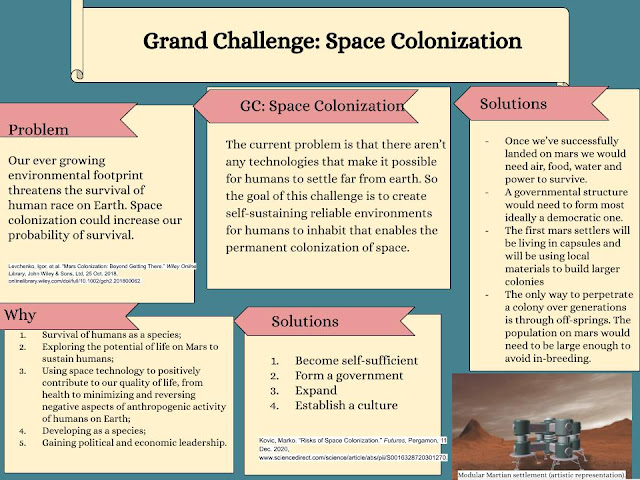
Grand Challenge: Space Colonization
Image
Welcome to my last ever action project! I am so happy to finally be able to type those words! This has been a difficult year and nonetheless a difficult semester. In this second and final unit of Frontiers , our main focus was on space exploration: astrophysics and astrology. We looked at the beginning of Earth and how it formed, learned about Kepler's Laws, looked at constellations, and more. Similar to the last action project, we continued our scientific research but this not for space exploration. For this action project, we were assigned to create a poster on a grand challenge in space exploration and find any possible solutions. As I was working on this project I learned about the future of humanity and what our plans are for when the earth is no longer inhabitable. Space colonization is something I also found interesting, so I chose that as my topic. Hope you enjoy it!
GR's Survival Guide to Becoming a Lawyer

Welcome to my final humanities action project! This year, I have learned to endure difficult situations, which is why I am so thrilled to graduate. In this unit of Endurance , we about the different types of endurance. The two kinds of endurance we learned about are endurance by force and endurance by choice. An example of endurance by force would be holocaust survivors. They are an example of endurance by force because they had to endure all the pain and suffering they went through. An example of endurance by choice is Laura Dekker who chose to become the youngest person to sail world the world alone. I have decided that I wanted to go into the legal field ever since sophomore year. For this action project, we were assigned to create a survival manual. My survival manual is focused on my path to becoming a lawyer. I hope you enjoy my project!

Grand Challenge 3: Understanding the Impact of Global Change on Marine Ecosystems

Image
 Welcome to my first action project for my last STEAM course ever at GCE Lab School, Frontiers. In this unit, we learned about coral reefs, blue carbon, geoengineering, and all things regarding oceanography. For an internal project, we were slipt into groups and in those groups, we were assigned a human impact on the ocean topic. My group's topic was "protect the marine ecosystems". In my research on this topic, I learned about rising sea levels, oil pollution in oceans, and the degradation of marine ecosystems as a result of climate change. I also learned the importance of the health of the ocean as humans rely on the ocean for food, water, and jobs. This group project was a helpful tool as it prepared me for this action project. For this action project, we were assigned to write a scientific paper that focused on one of the grand challenges in Marine Ecosystems Ecology. Hope you enjoy my project! Grand Challenge 3: Understanding the Impact of Global Change on Marine Eco...

The Debt Free College Act

Welcome to my final action project for my Humanities class, Equality . At the beginning of this class, we defined what equality is and what it looks like. We also learned about racial inequality, gender inequality, sexual orientation inequality, and class inequality. We discussed various legislations and the acts people have taken to reach equality, such as Affirmative action. Affirmative action is the active effort to improve racial and gender inequality in the workplace and education. Then we learned the ways socials constructs reinforce gender inequality. For this action project, we were asked to predict the future of equality by creating a time capsule from 100 years into the future. The focus of my project is class equality. I tackled this issue by envisioning a future where the president signs the Debt-Free College act. Below is my slideshow. I hope you enjoy this project as much as I enjoyed working on it!  Schatz, Brian. “Text - S.672 - 116th Congress (2019-2020): Debt-F...

Justice for Julius Jones

Image
Welcome to my final project of the Elective Term. This term I took a humanities course called Global Peace. In the past 3 weeks, we learned about Gandhi and his principles for peaceful protesting. We also learned about other examples of peacemakers like Martin Luther King Jr by watching Selma . Throughout the course, we also learned terms like Sarvodaya. Sarvodaya is the answer to all isms like socialism and capitalism because isms create separation and Sarvodaya is about raising together. To explain this concept Gandhi once said, " After I go, I do not want any ism. There should be no Gandhism." For the global part of this class, we compared ruling documents from countries around the world. For this action project, we were assigned to pick an issue we wanted to peacefully protest against. I chose to protest the death penalty. It would mean a lot of you could take a couple of seconds to sign this petition !

SDG2: Zero Hunger - Final Presentations

Welcome to the 2020 fall term final presentations. We were tasked to create a video covering one of the United Nations Sustainable Goals (SDGs) and create some possible solutions. In my group, we chose to cover SDG 2: Zero Hunger. Below is our video where we explain the SDG and the solutions we came up with.  Final Presentaions_ Fall 20 from T N on Vimeo . Acknowledgments:   TN is an aspiring actress and has a lot of background in film. She naturally led our group and pieced the video together and wrote a majority of the script. I helped with the research, but the video would not have been possible without her hard work! AG was also in my group and she helped come up with solutions to SDG2. She was always available and ready to work!  Works Cited:  Sophiabasa “ extreme poverty and hunger ” 2015 Nayan Hello World “ sustainable development goals ” 2019

Equitable Distribution of Wealth and Income

Image
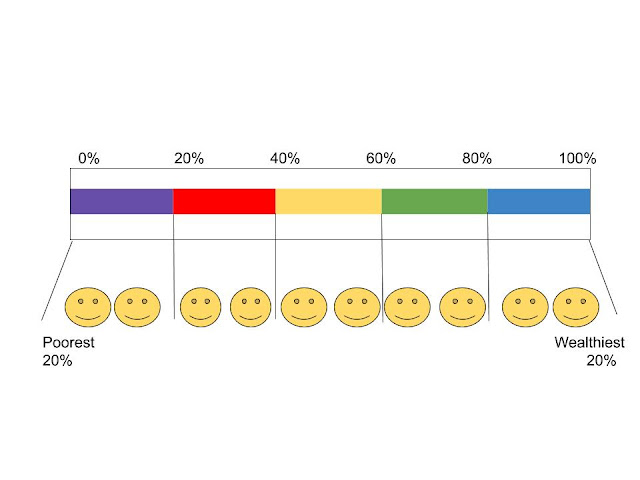
Hello, welcome to the second and final action project for my STEAM course Economy: Risking Value. In this unit, we read Doughnut Economics: Seven Ways to Think Like a 21st-Century Economist by Kate Raworth. The book is about how traditional economics is broken and how its outdated theories allow for the super-wealthy to continue to become super-wealthy while they are people living in poverty. It also covers the dangerous policies that threaten our future. We were split into seven different groups (one group per chapter). My group was assigned to read chapter 7 which is Be Agnostic About Growth. The other chapters were: 1. Change the goal, 2. See the big picture, 3. Nurture Human Nature, 4. Get Savvy with Systems, 5. Design to distribute, and 6. Create to Regenerate. Our task for this action project was to create our own economic perspective as the 8th chapter Following the guiding question, How do you view the economic world, keep scrolling to view my project.      ...

Is It Worth It?: The Debt of Law School

Image
Welcome to my first action project for my STEAM course Econ: Risking Value. Over the past 6 weeks, we have been looking at different economic terms like incentives, supply and demand, opportunity cost, and more. We also have been working on math concepts like matrices, compounding interest, and accruing interest. These concepts are ones that can be applied to everyday life. The guiding question for this project was "How do you determine the value of your college education?" in order to help us determine the answer to the question "What will you be doing after you graduate?” Keep scrolling down to see how I approached these questions. I interviewed a family friend about her experiences as a lawyer: 1. Where did you go to law school and do you regret your decision to attend this law school?    I graduated from the University of Illinois at Urbana Champingan Law school back in 2014. I do not regret my decision to attend this school because most of the interactions...

The Case that Ended Nixon's Presidency

In the past weeks in my humanities Course policy, we looked at how policy is created, who creates policy, and even how people react to policy. In this unit, we look specifically at the judicial branch of the United States of America. We studied the history of the supreme court and how it had little momentum at first until John Marshall came up with the idea of judicial review. We found out the constitution is very broad in article III unlike articles I and II. We also learned that the judicial branch is just as powerful as the other two branches of government. The judicial branch can make decisions that can create or abolish law for example in Roe v. Wade The supreme court ruled that the constitution of the United States protects a pregnant woman’s liberty to choose to have an abortion without government restriction. A more recent example of this is on June 26, 2015,  the United States Supreme Court held it in a 504 decision that required all states to grant same-sex marriages--Obe...

Truss Me On this!

Image
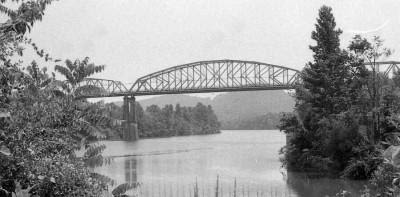
The first unit of Urban Planning has come to an end! Let's look back at what happened in this unit. First, we began by discussing the first part of A Devil in the White City. This discussion led to some deeper questionings on why urban planning even matters. Second, we were introduced to the many different types of bridges that are out there just to discover that it is even more than we initially thought. Then, we looked at the geometry behind these bridges especially focusing on triangles. Unfortunately due to COVID-19, we had to cancel all in-class instruction including field experiences. Nonetheless, our teacher was still able to get out there (Downtown Chicago), and show us the urban planning of our city through a video call. The inspiration behind my design is the K truss bridge. A real-life example of a K-truss bridge is the Austin Peay Bridge location in Jackson County, Tennessee. Dave King, "Austin Peay Bridge" Jan. 26 (2015) This was a very time-...

Naturalizing Language

Image
Over the past couple of weeks, in my humanities course, A Nation's Argument, we have been studying the events that led up to the ratification of the Bill of Rights. For us to gain a better understanding of the rights American citizens have under the U.S. Constitution, we looked at the first 15 amendments. We especially investigated the 13th amendment specifically, Article one which states, "Neither slavery nor involuntary servitude, except as a punishment for crime whereof the party shall have been duly convicted, shall exist within the United States, or any place subject to their jurisdiction." This amendment ties into what the discussions we had in class concerning the events that took place in the 1850s. As we moved forward into this unit, we also watched Ava DuVernay's documentary, 13th, to get an improved perception of the reality of the 13th amendment. Finally, we continued thinking about the rights American citizens have that are guaranteed under the U.S. Const...

Can you see what I hear?

Welcome to my second action project for my STEAM course, Light Sound and Time! In this unit, we investigated in the sound part of Light Sound and Time. First, we learned about the parts of the human ear and how we hear. Then we went over to the Chicago Hearing Society, where we talked to four hard of hearing people about their experiences being hard of hearing or deaf. Finally, we learned more about the Doppler effect, frequency vs. wavelength, and much more. To wrap up this unit, we were assigned to go out on our own to a music/guitar shop to learn more about guitars. This was a useful step that gave us a better idea of how guitars work so that we can eventually create our own. We did just that! For this action project, we were tasked to create a diddley bow. Below is my project! The process of building my diddley bow was a frustrating one, but in the end, everything turned out well. My classmates were having trouble tying the guitar string, so I kindly offered my ex...

Thought Without Fear

In my junior humanities course,  A Nation's Argument , we studied what makes up an argument. Throughout our investigation of this topic, we learned that in order for something to be considered an argument there must be two positions with an end goal of clarification. A part of learning about what makes up an argument, we learned about deductive and inductive reasoning. We also analyzed the United States' Declaration of Independence of 1776 to get a better idea of what an effective argument looks like. As we analyzed the United State's Declaration of Independence, we found that other countries had similar reasons for declaring independence. For Field Experiences, we went to Chicago City Hall where we watched aldermen pass ordinances. We also went and talked to Alderman Walter Burnett of the 27th ward about his 25-years as Alderman, and how he has been able to keep a solid argument for so long. To wrap up our first unit of this course,  Thesis: the 1770s , we were tasked to c...

Putting a Pin On it!

As we wrapped up the first unit of our STEAM course  Light sound and time,  we continued to ask ourselves, "What is light?" this question guided us in building our pinhole cameras. While building our cameras, we had to keep in mind the following questions: is the camera an example of refraction or reflection, why should the inside be completely black as opposed to white, and simply, how does a pinhole camera capture light? Before we even began thinking about the process of building the pinhole cameras, we learned about the electromagnetic spectrum, similar triangles, wave vs. particle, and more. Once we finished building our cameras and taking our photograph, we headed over to Harry S. Truman College to develop or images. Below are my project and my results. This was a very fun and engaging action project! I learned more about light while doing this project better than I did sitting in a classroom. If I were to do this again I would definitely make my pinhole s...

Uniting Through Art

Image
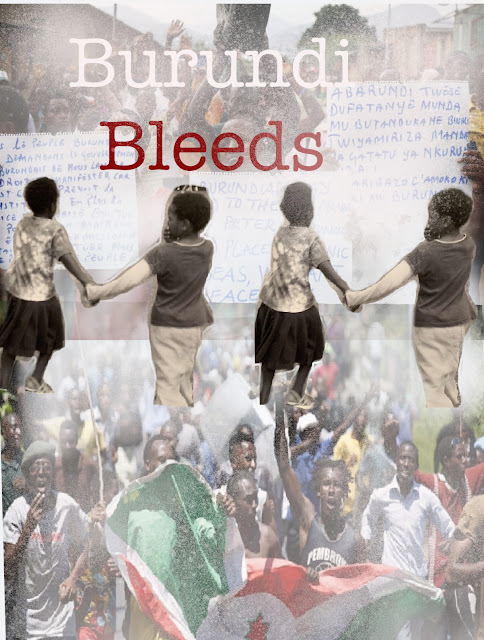
Welcome to my last action project for Rhetoric. In this unit, we looked at how people use rhetoric in public art to unite. We only went on one field experience this term: Marquette Park. We went there to look at the Martin Luther King, Jr. Living Memorial and the significance that the memorial has on the Marquette Park community. Throughout this unit, we talked about the events that led up to the American Revolution. While all these events were occurring, propaganda and public art were on the rise. Once the colonists in the colonies started to feel oppressed by the British, they started making art to humiliate the British to send a message. We also took a look at "how Cuban art fed Africa's liberation struggles". All these art pieces had one common goal: to unite. These historical art movements are what inspired this action project. I hope you enjoy it! GR. "Burundi Bleeds". (2019) Artist's Statement I am a 17-year-old Burundian immigrant living in t...

Wanna Change the Status Quo Sometime?

In my humanities course, Rhetoric, we have been studying the following question, "How can we use rhetoric to change the status quo?." We did this by digging deeper into the different rhetorical techniques. To answer this question, some local influential Chicagoans came to talk with us: Troy LaRaviere and Ugo Okere. Both of these men used their platforms to try to challenge and change the status quo. LaRaviere did so by publishing an opinion editorial (op-ed) to the Chicago Sun-Times calling out CPS policies and Rham Emmanual's administration's treatment of school administrators and Okere did so through his aldermanic campaign. After reading LaRaviere's op-ed, we were motivated to produce our own. Before doing so, we researched what makes an effective op-ed. If you are not too sure what an op-ed is, to simply put it, it is the commentary opposite page of the editorial page. In the process of making our op-ed, we were asked to respond to a timely issue of significan...

Pitcher This Design!

Welcome to my first action project for Biomimicry. Biomimicry is an elective course which focuses on STEAM. There are 3 units in this class: Plants, Animals, and Fungi. We just wrapped up Plants which was our first unit. In this unit, we went on a field experience to Interface, which is a company that makes sustainable rugs and carpets. At Interface, we talked to a man named Mikhail Davis who talked about biomimicry and how Interface's designs are inspired by nature. We also went to the Lincoln Park Conservatory, where we looked at different plants and tried to see if we could find the Fibonacci Series. On the first day our class, we were asked, "What is biomimicry?". No one had an accurate definition until further on into the unit. How I would define biomimicry is, "Biomimicry is when human-made designs are influenced or inspired by something in nature." We talked about different terms such as heterotrophs, autotrophs, parts of a tree, Fibonacci Series, Gaia H...

Patient Profile: Preventing a Heart Attack

Image
Welcome to my third and last action project for Cure. Cure is a course taken by the sophomore class here at GCE Lab School. There are 3 units in this course and we just first our last one titled Prevention. In this unit, we looked through different kinds of ways to prevent disease. We had a guest visitor who is a retired paramedic teach us how to perform cardiopulmonary resuscitation (CPR).  The importance of us learning how to perform CPR is so that we can know what to do when someone has gone into cardiac arrest. The only math skills that we learned were Theoretical and Experimental Probability. To wrap up this unit, we chose a specific symptom and or disease that we wanted to focus on and found a way to treat it by finding 3 different methods. We had to come up with a hypothetical character and make up their medical history, their family's medical history, and more. With all that information we had to give recommendations on how they can prevent a disease that runs their family....

Heterotopic Heart Transplant

Welcome to my first Action Project for Cure. Cure is a STEAM course taken by the sophomore class here at GCE. There are 3 units in this course and we just first our first one titled, Emergency. In this unit we looked at cell through microscopes, we learned the quadratic formula, we looked at how surgery has changed through history, and we learned much more. We took a field experience to the International Museum of Surgical Science to look at the history of surgery and how surgical tool have evolved since the early years of surgery. To wrap up this unit, this chose a specific surgery that we wanted to focus on. Below is my project on the surgery of my choice! Thanks for looking through my project! Overall, this project wasn't too difficult to complete. I enjoyed learning about what someone goes through after and before they go through and invasive surgery.  

Learn About ADHD

Image
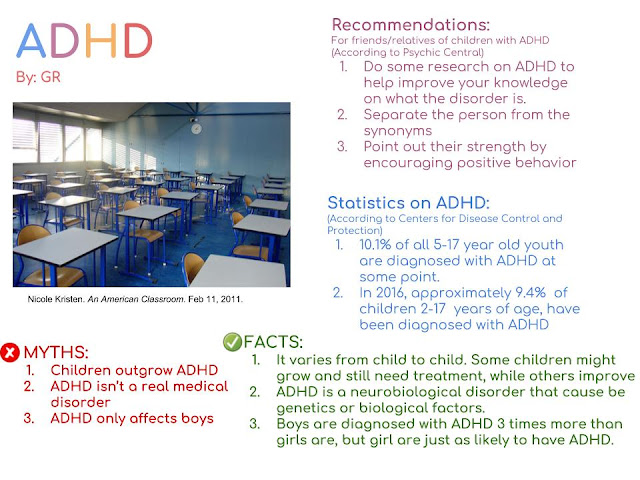
Welcome to my second action project for Disease. We just wrapped up our second unit called Mind . In Mind , we looked at the brain and focused different parts of the brain. Our main resource was the DMX-V file which is a textbook that has a long list of mental illnesses, including their symptoms. This book is often used by medical professionals when studying mental illnesses. To empathize with someone who has been diagnosed with schizophrenia, we took part in a simulation where we watched a video on what it's like to live with schizophrenia. For this action project, we did something similar to that. In this unit, we looked into different mental illnesses specially autism, schizophrenia, and we chose one that we wanted to research on our own. We looked deeply into autism and read a book by Naoki Nigashida called, The Reason I Jump. I chose to research attention deficit hyperactivity disorder (ADHD). I made a simulation and did a lot of research on what it's like to live with ADH...