Posts

Showing posts with the label Humanities

GR's Survival Guide to Becoming a Lawyer

Welcome to my final humanities action project! This year, I have learned to endure difficult situations, which is why I am so thrilled to graduate. In this unit of Endurance , we about the different types of endurance. The two kinds of endurance we learned about are endurance by force and endurance by choice. An example of endurance by force would be holocaust survivors. They are an example of endurance by force because they had to endure all the pain and suffering they went through. An example of endurance by choice is Laura Dekker who chose to become the youngest person to sail world the world alone. I have decided that I wanted to go into the legal field ever since sophomore year. For this action project, we were assigned to create a survival manual. My survival manual is focused on my path to becoming a lawyer. I hope you enjoy my project!

Justice for Julius Jones

Image
Welcome to my final project of the Elective Term. This term I took a humanities course called Global Peace. In the past 3 weeks, we learned about Gandhi and his principles for peaceful protesting. We also learned about other examples of peacemakers like Martin Luther King Jr by watching Selma . Throughout the course, we also learned terms like Sarvodaya. Sarvodaya is the answer to all isms like socialism and capitalism because isms create separation and Sarvodaya is about raising together. To explain this concept Gandhi once said, " After I go, I do not want any ism. There should be no Gandhism." For the global part of this class, we compared ruling documents from countries around the world. For this action project, we were assigned to pick an issue we wanted to peacefully protest against. I chose to protest the death penalty. It would mean a lot of you could take a couple of seconds to sign this petition !

The Case that Ended Nixon's Presidency

In the past weeks in my humanities Course policy, we looked at how policy is created, who creates policy, and even how people react to policy. In this unit, we look specifically at the judicial branch of the United States of America. We studied the history of the supreme court and how it had little momentum at first until John Marshall came up with the idea of judicial review. We found out the constitution is very broad in article III unlike articles I and II. We also learned that the judicial branch is just as powerful as the other two branches of government. The judicial branch can make decisions that can create or abolish law for example in Roe v. Wade The supreme court ruled that the constitution of the United States protects a pregnant woman’s liberty to choose to have an abortion without government restriction. A more recent example of this is on June 26, 2015,  the United States Supreme Court held it in a 504 decision that required all states to grant same-sex marriages--Obe...

Naturalizing Language

Image
Over the past couple of weeks, in my humanities course, A Nation's Argument, we have been studying the events that led up to the ratification of the Bill of Rights. For us to gain a better understanding of the rights American citizens have under the U.S. Constitution, we looked at the first 15 amendments. We especially investigated the 13th amendment specifically, Article one which states, "Neither slavery nor involuntary servitude, except as a punishment for crime whereof the party shall have been duly convicted, shall exist within the United States, or any place subject to their jurisdiction." This amendment ties into what the discussions we had in class concerning the events that took place in the 1850s. As we moved forward into this unit, we also watched Ava DuVernay's documentary, 13th, to get an improved perception of the reality of the 13th amendment. Finally, we continued thinking about the rights American citizens have that are guaranteed under the U.S. Const...

Thought Without Fear

In my junior humanities course,  A Nation's Argument , we studied what makes up an argument. Throughout our investigation of this topic, we learned that in order for something to be considered an argument there must be two positions with an end goal of clarification. A part of learning about what makes up an argument, we learned about deductive and inductive reasoning. We also analyzed the United States' Declaration of Independence of 1776 to get a better idea of what an effective argument looks like. As we analyzed the United State's Declaration of Independence, we found that other countries had similar reasons for declaring independence. For Field Experiences, we went to Chicago City Hall where we watched aldermen pass ordinances. We also went and talked to Alderman Walter Burnett of the 27th ward about his 25-years as Alderman, and how he has been able to keep a solid argument for so long. To wrap up our first unit of this course,  Thesis: the 1770s , we were tasked to c...

Uniting Through Art

Image
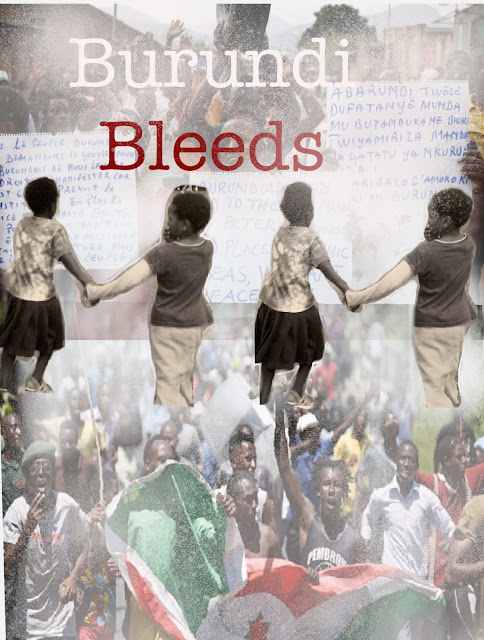
Welcome to my last action project for Rhetoric. In this unit, we looked at how people use rhetoric in public art to unite. We only went on one field experience this term: Marquette Park. We went there to look at the Martin Luther King, Jr. Living Memorial and the significance that the memorial has on the Marquette Park community. Throughout this unit, we talked about the events that led up to the American Revolution. While all these events were occurring, propaganda and public art were on the rise. Once the colonists in the colonies started to feel oppressed by the British, they started making art to humiliate the British to send a message. We also took a look at "how Cuban art fed Africa's liberation struggles". All these art pieces had one common goal: to unite. These historical art movements are what inspired this action project. I hope you enjoy it! GR. "Burundi Bleeds". (2019) Artist's Statement I am a 17-year-old Burundian immigrant living in t...

Wanna Change the Status Quo Sometime?

In my humanities course, Rhetoric, we have been studying the following question, "How can we use rhetoric to change the status quo?." We did this by digging deeper into the different rhetorical techniques. To answer this question, some local influential Chicagoans came to talk with us: Troy LaRaviere and Ugo Okere. Both of these men used their platforms to try to challenge and change the status quo. LaRaviere did so by publishing an opinion editorial (op-ed) to the Chicago Sun-Times calling out CPS policies and Rham Emmanual's administration's treatment of school administrators and Okere did so through his aldermanic campaign. After reading LaRaviere's op-ed, we were motivated to produce our own. Before doing so, we researched what makes an effective op-ed. If you are not too sure what an op-ed is, to simply put it, it is the commentary opposite page of the editorial page. In the process of making our op-ed, we were asked to respond to a timely issue of significan...

The Siskel to my Ebert

Image
Welcome, to my second action project for Ollywood. Ollywood is an Elective course here at GCE Lab School. There are 3 units in this class: Pre-Production, Production, and Post-Production. We are wrapping up our second unit named Production. In this unit, we talked about the different elements and jobs that take place in this producing a film. Some elements and jobs we studied are acting, lights, and cinematography. We had a couple of field experiences in this unit.  We went to the Goodman Theater where were watched A Christmas Carol, a couple of employees from the Goodman Theater came to our school and talked to us about what their positions are at the Goodman. When they were here they also helped us with some table reading since we were transitioning from unit 1, Pre-Production to unit 2, Production. In class, we also talked and watched a couple of videos from movie critics Siskel and Ebert. They were two men who would critic films and sometimes argue with each others opinion but ...

Let Them Eat Cake

Image
Welcome to my first action project for Ollywood. Ollywood is an elective course with 3 units, Pre-Production, Production, and Post-Production. We just wrapped up the first unit, Pre-Production. In this unit, we learned about jobs that need to happen before shooting a film. Screenplay, storyboards, location scouting, and production design are all jobs that take place in Pre-production. We did a little activity where we were split up into assigned groups based on the genre of film we were given. With the genre of film we were assigned to, we had to find a location that would be appropriate to our genre and hypothetical film there. The genre I had was, action film: chase scene. I did a little research on where popular action films have filmed chase scene in Chicago and I came across Lower Wacker Drive. Films like Wanted, The Dark Night, The Blues Brothers, and many more has filmed at Lower Wacker Drive. I chose Lower Wacker Dr. as my appropriate location to film an action chase scene. Luc...

A Hero's Journey!

Welcome to the last Action Project of the Stories. Stories is a humanities course that the sophomores of GCE Lab School take. There are 3 units in this course, and we just wrapped up our last unit of this course. In this unit, we talked about Joseph Campbell's Monomyth-- the 12 stages of a hero's journey. Those 12 stages are Call to Adventure, Refusal of Call, Supernatural Aid, Crossing 1st Threshold, Belly of the Whale, Road of Trial, Meeting with the Goddess, Temptation, Atonement with the Father, Apostasis, Ultimate Boon, Refusal of Return, Magic Fight, Rescue from Without, Crossing Return Threshold, Master of Two Words, and Freedom to Live. For this action project our guiding question was, How do you analyze a hero? We were asked to compare 2 heroes. One fictional hero and one real life hero. The heroes that I chose to talk about were my brother, Leandre and the Flash from the television series named The Flash. I chose the Flash as my fictional hero because he has all the ...