Posts

Naturalizing Language

Image
Over the past couple of weeks, in my humanities course, A Nation's Argument, we have been studying the events that led up to the ratification of the Bill of Rights. For us to gain a better understanding of the rights American citizens have under the U.S. Constitution, we looked at the first 15 amendments. We especially investigated the 13th amendment specifically, Article one which states, "Neither slavery nor involuntary servitude, except as a punishment for crime whereof the party shall have been duly convicted, shall exist within the United States, or any place subject to their jurisdiction." This amendment ties into what the discussions we had in class concerning the events that took place in the 1850s. As we moved forward into this unit, we also watched Ava DuVernay's documentary, 13th, to get an improved perception of the reality of the 13th amendment. Finally, we continued thinking about the rights American citizens have that are guaranteed under the U.S. Const...
Can you see what I hear?

Welcome to my second action project for my STEAM course, Light Sound and Time! In this unit, we investigated in the sound part of Light Sound and Time. First, we learned about the parts of the human ear and how we hear. Then we went over to the Chicago Hearing Society, where we talked to four hard of hearing people about their experiences being hard of hearing or deaf. Finally, we learned more about the Doppler effect, frequency vs. wavelength, and much more. To wrap up this unit, we were assigned to go out on our own to a music/guitar shop to learn more about guitars. This was a useful step that gave us a better idea of how guitars work so that we can eventually create our own. We did just that! For this action project, we were tasked to create a diddley bow. Below is my project! The process of building my diddley bow was a frustrating one, but in the end, everything turned out well. My classmates were having trouble tying the guitar string, so I kindly offered my ex...

Thought Without Fear

In my junior humanities course,  A Nation's Argument , we studied what makes up an argument. Throughout our investigation of this topic, we learned that in order for something to be considered an argument there must be two positions with an end goal of clarification. A part of learning about what makes up an argument, we learned about deductive and inductive reasoning. We also analyzed the United States' Declaration of Independence of 1776 to get a better idea of what an effective argument looks like. As we analyzed the United State's Declaration of Independence, we found that other countries had similar reasons for declaring independence. For Field Experiences, we went to Chicago City Hall where we watched aldermen pass ordinances. We also went and talked to Alderman Walter Burnett of the 27th ward about his 25-years as Alderman, and how he has been able to keep a solid argument for so long. To wrap up our first unit of this course,  Thesis: the 1770s , we were tasked to c...

Putting a Pin On it!

As we wrapped up the first unit of our STEAM course  Light sound and time,  we continued to ask ourselves, "What is light?" this question guided us in building our pinhole cameras. While building our cameras, we had to keep in mind the following questions: is the camera an example of refraction or reflection, why should the inside be completely black as opposed to white, and simply, how does a pinhole camera capture light? Before we even began thinking about the process of building the pinhole cameras, we learned about the electromagnetic spectrum, similar triangles, wave vs. particle, and more. Once we finished building our cameras and taking our photograph, we headed over to Harry S. Truman College to develop or images. Below are my project and my results. This was a very fun and engaging action project! I learned more about light while doing this project better than I did sitting in a classroom. If I were to do this again I would definitely make my pinhole s...

Uniting Through Art

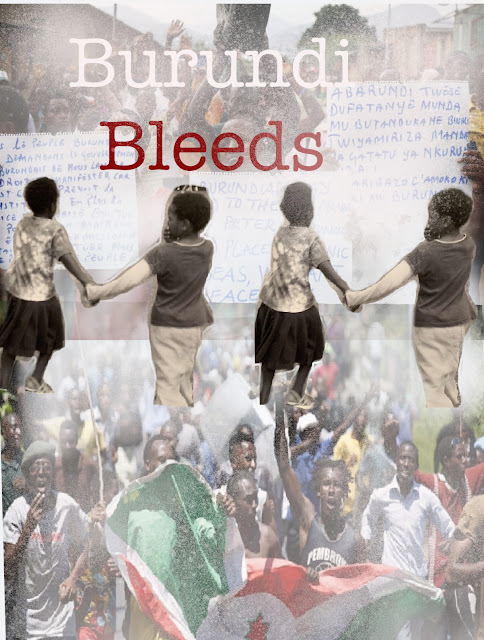
Image
Welcome to my last action project for Rhetoric. In this unit, we looked at how people use rhetoric in public art to unite. We only went on one field experience this term: Marquette Park. We went there to look at the Martin Luther King, Jr. Living Memorial and the significance that the memorial has on the Marquette Park community. Throughout this unit, we talked about the events that led up to the American Revolution. While all these events were occurring, propaganda and public art were on the rise. Once the colonists in the colonies started to feel oppressed by the British, they started making art to humiliate the British to send a message. We also took a look at "how Cuban art fed Africa's liberation struggles". All these art pieces had one common goal: to unite. These historical art movements are what inspired this action project. I hope you enjoy it! GR. "Burundi Bleeds". (2019) Artist's Statement I am a 17-year-old Burundian immigrant living in t...

Wanna Change the Status Quo Sometime?

In my humanities course, Rhetoric, we have been studying the following question, "How can we use rhetoric to change the status quo?." We did this by digging deeper into the different rhetorical techniques. To answer this question, some local influential Chicagoans came to talk with us: Troy LaRaviere and Ugo Okere. Both of these men used their platforms to try to challenge and change the status quo. LaRaviere did so by publishing an opinion editorial (op-ed) to the Chicago Sun-Times calling out CPS policies and Rham Emmanual's administration's treatment of school administrators and Okere did so through his aldermanic campaign. After reading LaRaviere's op-ed, we were motivated to produce our own. Before doing so, we researched what makes an effective op-ed. If you are not too sure what an op-ed is, to simply put it, it is the commentary opposite page of the editorial page. In the process of making our op-ed, we were asked to respond to a timely issue of significan...

Pitcher This Design!

Welcome to my first action project for Biomimicry. Biomimicry is an elective course which focuses on STEAM. There are 3 units in this class: Plants, Animals, and Fungi. We just wrapped up Plants which was our first unit. In this unit, we went on a field experience to Interface, which is a company that makes sustainable rugs and carpets. At Interface, we talked to a man named Mikhail Davis who talked about biomimicry and how Interface's designs are inspired by nature. We also went to the Lincoln Park Conservatory, where we looked at different plants and tried to see if we could find the Fibonacci Series. On the first day our class, we were asked, "What is biomimicry?". No one had an accurate definition until further on into the unit. How I would define biomimicry is, "Biomimicry is when human-made designs are influenced or inspired by something in nature." We talked about different terms such as heterotrophs, autotrophs, parts of a tree, Fibonacci Series, Gaia H...