Posts

Showing posts with the label STEAM

Grand Challenge: Space Colonization
Image
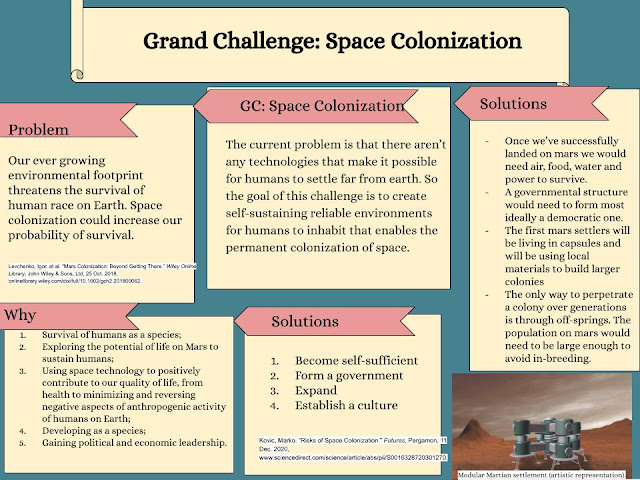
Welcome to my last ever action project! I am so happy to finally be able to type those words! This has been a difficult year and nonetheless a difficult semester. In this second and final unit of Frontiers , our main focus was on space exploration: astrophysics and astrology. We looked at the beginning of Earth and how it formed, learned about Kepler's Laws, looked at constellations, and more. Similar to the last action project, we continued our scientific research but this not for space exploration. For this action project, we were assigned to create a poster on a grand challenge in space exploration and find any possible solutions. As I was working on this project I learned about the future of humanity and what our plans are for when the earth is no longer inhabitable. Space colonization is something I also found interesting, so I chose that as my topic. Hope you enjoy it!
Grand Challenge 3: Understanding the Impact of Global Change on Marine Ecosystems

Image
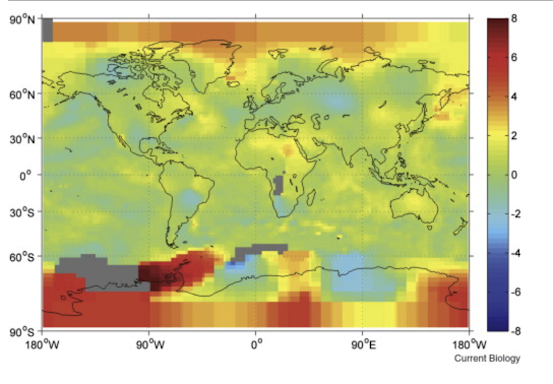
 Welcome to my first action project for my last STEAM course ever at GCE Lab School, Frontiers. In this unit, we learned about coral reefs, blue carbon, geoengineering, and all things regarding oceanography. For an internal project, we were slipt into groups and in those groups, we were assigned a human impact on the ocean topic. My group's topic was "protect the marine ecosystems". In my research on this topic, I learned about rising sea levels, oil pollution in oceans, and the degradation of marine ecosystems as a result of climate change. I also learned the importance of the health of the ocean as humans rely on the ocean for food, water, and jobs. This group project was a helpful tool as it prepared me for this action project. For this action project, we were assigned to write a scientific paper that focused on one of the grand challenges in Marine Ecosystems Ecology. Hope you enjoy my project! Grand Challenge 3: Understanding the Impact of Global Change on Marine Eco...

Equitable Distribution of Wealth and Income

Image
Hello, welcome to the second and final action project for my STEAM course Economy: Risking Value. In this unit, we read Doughnut Economics: Seven Ways to Think Like a 21st-Century Economist by Kate Raworth. The book is about how traditional economics is broken and how its outdated theories allow for the super-wealthy to continue to become super-wealthy while they are people living in poverty. It also covers the dangerous policies that threaten our future. We were split into seven different groups (one group per chapter). My group was assigned to read chapter 7 which is Be Agnostic About Growth. The other chapters were: 1. Change the goal, 2. See the big picture, 3. Nurture Human Nature, 4. Get Savvy with Systems, 5. Design to distribute, and 6. Create to Regenerate. Our task for this action project was to create our own economic perspective as the 8th chapter Following the guiding question, How do you view the economic world, keep scrolling to view my project.      ...

Is It Worth It?: The Debt of Law School

Image
Welcome to my first action project for my STEAM course Econ: Risking Value. Over the past 6 weeks, we have been looking at different economic terms like incentives, supply and demand, opportunity cost, and more. We also have been working on math concepts like matrices, compounding interest, and accruing interest. These concepts are ones that can be applied to everyday life. The guiding question for this project was "How do you determine the value of your college education?" in order to help us determine the answer to the question "What will you be doing after you graduate?” Keep scrolling down to see how I approached these questions. I interviewed a family friend about her experiences as a lawyer: 1. Where did you go to law school and do you regret your decision to attend this law school?    I graduated from the University of Illinois at Urbana Champingan Law school back in 2014. I do not regret my decision to attend this school because most of the interactions...

Truss Me On this!

Image
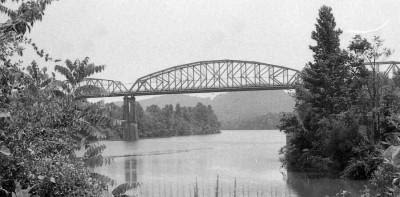
The first unit of Urban Planning has come to an end! Let's look back at what happened in this unit. First, we began by discussing the first part of A Devil in the White City. This discussion led to some deeper questionings on why urban planning even matters. Second, we were introduced to the many different types of bridges that are out there just to discover that it is even more than we initially thought. Then, we looked at the geometry behind these bridges especially focusing on triangles. Unfortunately due to COVID-19, we had to cancel all in-class instruction including field experiences. Nonetheless, our teacher was still able to get out there (Downtown Chicago), and show us the urban planning of our city through a video call. The inspiration behind my design is the K truss bridge. A real-life example of a K-truss bridge is the Austin Peay Bridge location in Jackson County, Tennessee. Dave King, "Austin Peay Bridge" Jan. 26 (2015) This was a very time-...

Can you see what I hear?

Welcome to my second action project for my STEAM course, Light Sound and Time! In this unit, we investigated in the sound part of Light Sound and Time. First, we learned about the parts of the human ear and how we hear. Then we went over to the Chicago Hearing Society, where we talked to four hard of hearing people about their experiences being hard of hearing or deaf. Finally, we learned more about the Doppler effect, frequency vs. wavelength, and much more. To wrap up this unit, we were assigned to go out on our own to a music/guitar shop to learn more about guitars. This was a useful step that gave us a better idea of how guitars work so that we can eventually create our own. We did just that! For this action project, we were tasked to create a diddley bow. Below is my project! The process of building my diddley bow was a frustrating one, but in the end, everything turned out well. My classmates were having trouble tying the guitar string, so I kindly offered my ex...

Putting a Pin On it!

As we wrapped up the first unit of our STEAM course  Light sound and time,  we continued to ask ourselves, "What is light?" this question guided us in building our pinhole cameras. While building our cameras, we had to keep in mind the following questions: is the camera an example of refraction or reflection, why should the inside be completely black as opposed to white, and simply, how does a pinhole camera capture light? Before we even began thinking about the process of building the pinhole cameras, we learned about the electromagnetic spectrum, similar triangles, wave vs. particle, and more. Once we finished building our cameras and taking our photograph, we headed over to Harry S. Truman College to develop or images. Below are my project and my results. This was a very fun and engaging action project! I learned more about light while doing this project better than I did sitting in a classroom. If I were to do this again I would definitely make my pinhole s...

Pitcher This Design!

Welcome to my first action project for Biomimicry. Biomimicry is an elective course which focuses on STEAM. There are 3 units in this class: Plants, Animals, and Fungi. We just wrapped up Plants which was our first unit. In this unit, we went on a field experience to Interface, which is a company that makes sustainable rugs and carpets. At Interface, we talked to a man named Mikhail Davis who talked about biomimicry and how Interface's designs are inspired by nature. We also went to the Lincoln Park Conservatory, where we looked at different plants and tried to see if we could find the Fibonacci Series. On the first day our class, we were asked, "What is biomimicry?". No one had an accurate definition until further on into the unit. How I would define biomimicry is, "Biomimicry is when human-made designs are influenced or inspired by something in nature." We talked about different terms such as heterotrophs, autotrophs, parts of a tree, Fibonacci Series, Gaia H...

Patient Profile: Preventing a Heart Attack

Image
Welcome to my third and last action project for Cure. Cure is a course taken by the sophomore class here at GCE Lab School. There are 3 units in this course and we just first our last one titled Prevention. In this unit, we looked through different kinds of ways to prevent disease. We had a guest visitor who is a retired paramedic teach us how to perform cardiopulmonary resuscitation (CPR).  The importance of us learning how to perform CPR is so that we can know what to do when someone has gone into cardiac arrest. The only math skills that we learned were Theoretical and Experimental Probability. To wrap up this unit, we chose a specific symptom and or disease that we wanted to focus on and found a way to treat it by finding 3 different methods. We had to come up with a hypothetical character and make up their medical history, their family's medical history, and more. With all that information we had to give recommendations on how they can prevent a disease that runs their family....

Heterotopic Heart Transplant

Welcome to my first Action Project for Cure. Cure is a STEAM course taken by the sophomore class here at GCE. There are 3 units in this course and we just first our first one titled, Emergency. In this unit we looked at cell through microscopes, we learned the quadratic formula, we looked at how surgery has changed through history, and we learned much more. We took a field experience to the International Museum of Surgical Science to look at the history of surgery and how surgical tool have evolved since the early years of surgery. To wrap up this unit, this chose a specific surgery that we wanted to focus on. Below is my project on the surgery of my choice! Thanks for looking through my project! Overall, this project wasn't too difficult to complete. I enjoyed learning about what someone goes through after and before they go through and invasive surgery.  

Learn About ADHD

Image
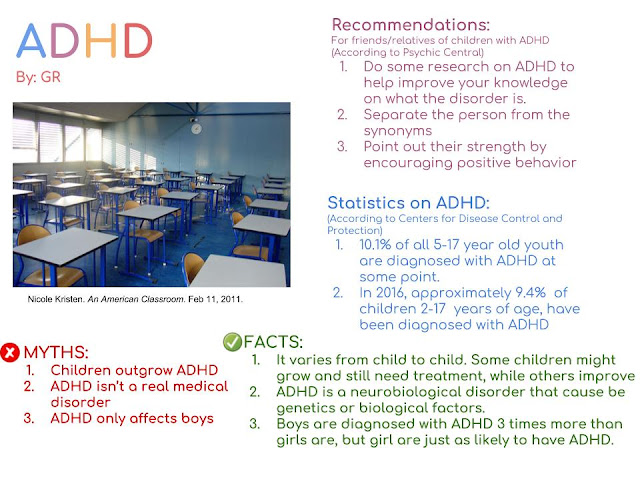
Welcome to my second action project for Disease. We just wrapped up our second unit called Mind . In Mind , we looked at the brain and focused different parts of the brain. Our main resource was the DMX-V file which is a textbook that has a long list of mental illnesses, including their symptoms. This book is often used by medical professionals when studying mental illnesses. To empathize with someone who has been diagnosed with schizophrenia, we took part in a simulation where we watched a video on what it's like to live with schizophrenia. For this action project, we did something similar to that. In this unit, we looked into different mental illnesses specially autism, schizophrenia, and we chose one that we wanted to research on our own. We looked deeply into autism and read a book by Naoki Nigashida called, The Reason I Jump. I chose to research attention deficit hyperactivity disorder (ADHD). I made a simulation and did a lot of research on what it's like to live with ADH...

Echo not my location, but my design!

Welcome to my 3rd action project for Biomimicry. Biomimicry is an elective course which focuses on STEAM. There are 3 units in this class: Like A Plant, Like an Animal, and Like A Fungus. We just wrapped up Like A Fungus which was our last unit. In this unit, we learned about how things decompose, the difference between a food chain and a food web, organic vs inorganic matter, and many more. For this unit there were two Field Experiences that my class went on, to The Plant and Sharayu from Healthy Soil Compost came in and talked to us about vermicomposting. for this action project our goal is to re-make a product that is sustainable and that is a closed loop system. below is my design.   I had a great time re-creating something sustainable that has now become apart of a lot of people's daily lives. This was a cool project because I got to think about where things go after they are out of use. It was hard to find information on the Echo Dot so it made it a lot harder for m...

WHAT IN THE ANIMAL MIMICKING?!

Welcome to my second action project for Biomimicry. Biomimicry is an elective course which focuses on STEAM. There are 3 units in this class: Like A Plant, Like an Animal, and Like A Fungus. We just wrapped up Animals which was our second unit. In this unit, we learned about how different designs are inspired by animals. We learned terms like aerodynamics, Bernoulli's principle, the scientific method, and many more. We also learned about the 3 ways we can learn from animals. These 3 ways are Form, Process, and Ecosystem. In this unit, we didn't go on any Field Experiences because we brought the experiences to us. We had two different guests come in, one was Amy from Biomimicry Chicago and the other was Maya. Maya really helped us with our projects because she is an architect and she helped us create our designs which is something she does in her work as an architect. For this action project, we were challenged to create a 3D model of a sustainable structure and a vehicle that w...

Humans vs. African Painted Dogs, Who Will Win?

Image
Welcome to the last unit of Population! This unit was 3 weeks and we covered a lot of information. We talked about symbiotic relationships, growth in populations, line graphs, arithmetic and geometric sequences, and Thomas Malthus. The guiding question for this action project , How does human population growth affect other populations? In order to approach this question, I will be comparing the African Painted Dogs to humans and see the difference in population growth. Symbiotic relationships are interactions between two organisms. There are 7 different types of symbiotic relationships. All organisms interact in different ways. Sometimes they benefit from one another for an example, Bees and flowers. Bees provide flowers with the mean to reproduce and flowers provide bees with nectar and pollen. Sometimes organisms compete against each other for an example, Tigers and Lions. Tigers and Lions could compete for the same prey. For this action project, we were asked to compare our organis...

Lycaon Pictus

Image
Welcome Hello! Welcome to my first action project for my STEAM course named Population. In this class we learned about taxonomy, sets and subsets, Carl Linnaeus, and more. Over the summer, we were assigned to read a book named, In The Shadow of Man by Jane Goodall. I enjoyed this book because I got to learn about some similarities and differences between chimpanzees and humans. It actually turns out that there are a lot more similarities than differences. We also took a Field Experience to the Lincoln Park Zoo, where we chose an animal and observed its behaviors. I chose the African Painted Dog. I chose this organism because I did not have much knowledge about them so I thought that it was the perfect opportunity for me to learn about them. Below is some research that I gathered up about African Painted Dogs. Intro The largest populations of the African Painted Dog remains in Southern Africa and some parts of southern East Africa. African Painted Dogs are usually social and tra...

All Dough

Hello, welcome to Food. The freshmen at GCE Lab School have been baking bread. Now you might be confused as to why a school is making their students bake bread instead of doing work from their textbook. But this is not a traditional school. We just wrapped up our unit 2 for our STEAM class called Cooking. We started this unit off by kneading flour and water. We went on 1 field experience to Big Delicious Planet, which is basically a restaurant that has a farm right next to it. They grow their own food so they are very organic. I think this restaurant inspired us to make and bake our own bread with a leading question of: Does using different leavening agents affect the outcome of our bread? There were 5 different groups for the 5 different kind of breads that we baked. My group had Homemade Sourdough Bread. To find out how our bread turned out continue reading!